
Stuck Payouts: Using the Accelerator When a Withdrawal Lags
A withdrawal that reads as sent but never confirms is a mempool problem, not an accounting problem. At 205 TH/s the pool credits 0.00009196 BTC a day, roughly $7.79 before the listed 4%, and that figure keeps arriving whether or not an earlier transaction has confirmed. What the wait really costs is access to coins you already own, and that is the part an accelerator is designed to shorten.

Key takeaways
- Confirmation and credit are separate events: 205 TH/s still earns 0.00009196 BTC a day while an old withdrawal sits unconfirmed.
- The free lane needs two conditions at once, a transaction of 0.5 KB or less and a fee rate of at least 0.0001 BTC/KB.
- Free capacity refreshes hourly and is handled in submission order, so a rejected attempt is not a permanent verdict.
- Once submitted, a paid acceleration cannot be called back and carries no refund, so verify the inputs first.
What a pending withdrawal actually blocks
Under PPS+, the block-reward side of your income settles hourly against current difficulty. That schedule runs on its own clock. A withdrawal that has left the pool but not yet entered a block does not pause the next credit, does not reduce it and does not put it at risk. The coins in the pending transaction are simply unavailable for spending until a miner includes them.
This distinction matters because miners often treat the two as one event. They are not. The pool owes you a balance, pays it to an address you control, and then the network decides when that payment becomes final. If the transaction was built with a fee rate below what the mempool currently clears at, the last step can stretch from minutes into days, and no amount of hashrate moves it along.
Two gates decide whether the free lane applies
The free route has a narrow doorway. The transaction must be 0.5 KB or smaller, and its fee rate must be at least 0.0001 BTC/KB. Both conditions are checked against the transaction as submitted, so a large consolidation with many inputs will fail the first gate even if its fee rate is generous. A small payment with a thin fee fails the second.
Capacity is also finite. Free submissions are handled against an hourly quota in the order they arrive, which means a valid request can still miss the window if it lands late in the hour. The practical response is to try again at the top of the next hour rather than to assume the tool is broken. Paid acceleration is the alternative when the amount at stake justifies the charge, and the fee can be settled in BTC, BCH or LTC straight from the account balance.
The ViaBTC TX Accelerator checks both gates at the moment of submission, so a rejection tells you which condition failed. Copy the transaction ID, its size in kilobytes and its fee rate into a note before trying again. Those three values explain almost every outcome, and they are much easier to read from a note than from a scrolling history at two in the morning. If the size is the problem, a fresh withdrawal built from fewer inputs will clear the first gate without any other change.
Where the transaction goes after submission
A submitted transaction is queued for the next block that the pool mines. That is a commitment of priority, not a promise about the clock: block discovery is probabilistic, so the wait depends on when the next block is found. Two constraints are worth knowing before you press the button. The request cannot be canceled, and the payment is not refunded. There is also no support for double-spends, and if the transaction spends inputs that are themselves unconfirmed, it cannot be accelerated until the parent confirms.
That last rule catches people who chain withdrawals in a hurry. If you send a small test payment and then immediately move the change, the second transaction inherits an unconfirmed parent. The fix is to accelerate the earlier one and let it confirm before touching the later one. Planning withdrawals so that each spends only confirmed outputs avoids the queue entirely.
Sizing the stake in BTC and dollars
Whether a paid acceleration makes sense depends on the value being freed, not on the size of the fee in isolation. A week of production at 205 TH/s is 0.00064372 BTC, about $54.52 at $84,692. Waiting two extra days on that amount is a delay in access, not a loss of principal, but if the coins are needed for a power bill the timing has a real cost.
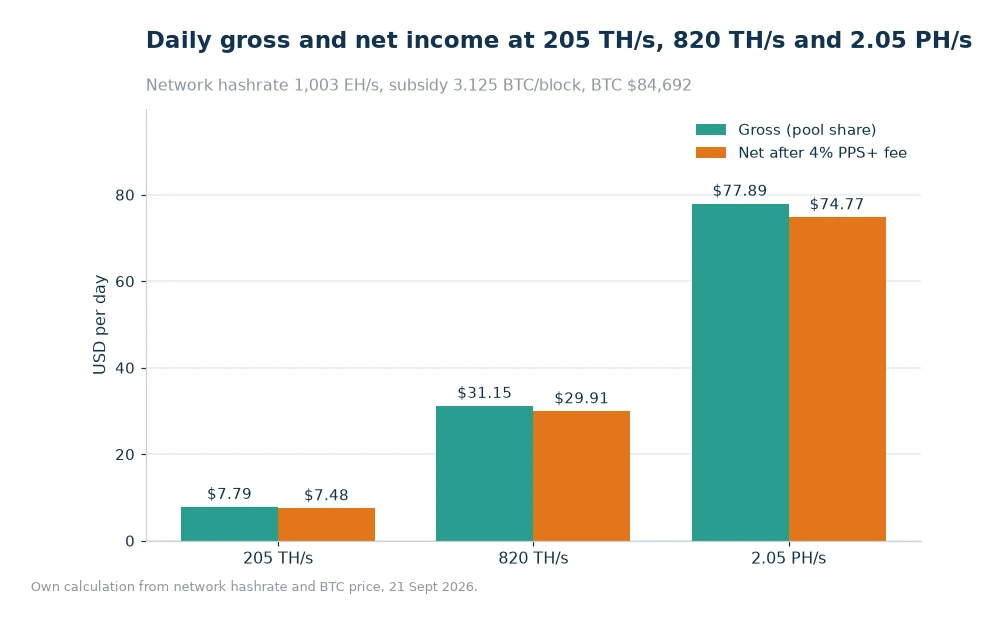
Larger hashrate changes the picture by scale alone. At 820 TH/s the daily credit is 0.00036789 BTC, and at 2.05 PH/s it is 0.00091964 BTC. A pending withdrawal from a large operation can therefore be worth many multiples of a small one, while the cost of accelerating depends on the transaction's size and fee rate rather than on the amount it carries. That mismatch is why farms consolidate carefully and home miners often do not need the paid option at all.
When the free lane closes, price the alternative
There are two honest responses to a rejected free request. The first is to wait for the next hourly window and try again with the same transaction, which costs nothing but time. The second is to pay, which buys priority but not certainty about when the next block appears. Choosing between them is a comparison of two costs: the value of waiting, and the fee quoted for the paid route.
The waiting cost is easy to estimate because production continues. At 205 TH/s, one day of credit is 0.00009196 BTC, so each day of delay in accessing an already-earned balance is a day in which that balance cannot be used for anything else. If the balance is not needed, waiting is free in the only sense that matters. If it is needed for a bill, the paid route may be cheaper than the consequence of missing a date. The listed rates behind the credit sit on the pricing page, which is worth reading before assuming the fee applies uniformly to the entire payout.
| Machine size | Coins mined daily | Gross value | Value after fee |
|---|---|---|---|
| 205 TH/s | 0.00009196 | $7.79 | $7.48 |
| 820 TH/s | 0.00036789 | $31.15 | $29.91 |
| 2.05 PH/s | 0.00091964 | $77.89 | $74.77 |
Worked example
Start from the network and work down to a single withdrawal, so every number in the table can be reproduced.
- One terahash earns 450 ÷ 1,003,000,000, which works out to 0.00000044865 BTC.
- Scale to the rig: 205 × 0.00000044865 = 0.00009197, rounded to 0.00009196 for the table, which is 9.196e-05 BTC a day.
- In dollars: 0.00009196 × 84,692 = $7.79 gross.
- After the listed 4% on the block-reward component: 7.79 × 0.96 = $7.48.
- A seven-day batch: 7 × 0.00009196 = 0.00064372 BTC, or $54.52.
- If that batch waits an extra 30 hours, the delay is 30 ÷ 24 × $7.79 = $9.74 of production sitting behind it rather than in front of it.
The arithmetic says something simple about priority. The accelerator does not raise the output of the machine and does not touch the fee schedule. It changes the order in which the network sees a transaction you have already been paid. Judge it against the value of getting those specific coins movable again, and against the alternative of simply building smaller, cheaper withdrawals in the first place.
Frequently asked questions
Does accelerating a transaction change what the pool has already credited me?
No. At 205 TH/s the credit stays 0.00009196 BTC a day, or $7.48 after the listed 4%, because settlement follows difficulty and shares; confirmation only decides when the withdrawn coins become spendable.
Why was my free submission turned away?
The free lane requires a transaction of 0.5 KB or less with a fee rate of at least 0.0001 BTC/KB, and it also runs against an hourly quota in arrival order, so a valid request can miss the current window.
Can a paid acceleration be canceled or refunded?
No. A paid submission is final, carries no refund, and is included in the next block the pool mines, which means the timing depends on block discovery rather than on a fixed clock.
Build the withdrawal before you need to rescue it
Most stuck-transaction stories start with a consolidation made in a hurry. Keep withdrawal sizes modest, watch the fee rate against the 0.0001 BTC/KB line, and avoid spending outputs that have not confirmed. If a transaction does stall, check its size and fee rate first, then check whether its inputs are confirmed, and only then decide between the free queue and the paid route. The multi-currency wallet keeps the balance and the withdrawal history in one place, which makes the size of the pending amount easy to read before you act.
Sources: ViaBTC accelerator and fee pages for the free-lane conditions, the hourly quota, the paid options and the listed 4%[1]. Market and chain snapshot, 21 September 2026: 1,003 EH/s across the network, a 3.125 BTC subsidy every block, 144 blocks each day, BTC at $84,692. This page went live on 24 October 2026; the dollar columns come from that snapshot.